
JASC News
Airbus Delivers Second A380 to Singapore Airlines
With the first A380 flying daily between Singapore and Sydney, Airbus has delivered the second A380 to Singapore Airlines this month. Each A380 has a Pratt & Whitney Canada PW-980 APU (Auxiliary Power Unit) installed in its tail. JASC designed and builds the Fuel Metering Valve and Inlet Guide Vane Actuator used on the PW-980.
The APU provides power for such things as the air conditioning, hydraulic systems and the plane’s electronics when the main engines are not running. This also includes the capability of providing emergency power during flight.

Pictured during the A380’s visit to LAX in November of 2007, the tail section houses the PW-980 APU which provides power for the plane’s air conditioning, hydraulic systems and electronic systems when the plane’s main engines are not running.
JASC’s extensive design experience with aerospace fluid controls as well as fueldraulic and pneumatic actuators have led to numerous design innovations that are helping expand the envelope of powered flight. From providing control components on commercial aircraft (Airbus A320 and A380, Boeing 717 and 787) to our cutting-edge fuel control and actuator innovations (used on NASA’s X-43A Hyper-X and SED X-51A and the ONR RATTLRS program), we’re helping pave the path to the future in aerospace.
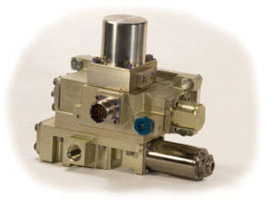
JASC’s Fuel Metering Valve is used on the Airbus A380’s APU to provide precise fuel flow to the engine.

JASC’s Inlet Guide Vane Actuator is used on the Airbus A380’s APU to help regulate the load placed on the fast turning turbine engine.
Printable .pdf version (requires the free Adobe Reader)
JASC Delivers First Variable Guide Vane Actuator System for LibertyWorks YJ102R Engine
JASC has delivered the first Variable Guide Vane Actuator (VGVA) system for the Rolls-Royce LibertyWorks YJ102R engine. The YJ102R will power the RATTLRS quick-strike technology demonstrator vehicle developed by Lockheed Martin for the U.S Navy. The JASC Variable Guide Vane Actuator is used to adjust the angle of the engine’s guide vanes and will operate throughout the vehicle’s speed envelope, ranging from subsonic launch to speeds greater than Mach 3.
When traveling above Mach 2, friction between the air and the vehicle generates high temperatures requiring the use of non-traditional materials and techniques. The same holds true
for components mounted on and around the RATTLRS engine. The extreme temperatures the VGVA will be exposed to required JASC to develop an innovative solution. This design involved the use of a multi-piston actuator as well as the electronic controller used to position the actuator.
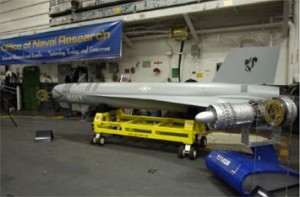
Pictured during Fleet Week 2006, a mock-up of the RATTLRS vehicle and the YJ102R (which will power the RATTLRS vehicle) are on display. Noteworthy in the vehicle’s overall shape is the design heritage drawn from the SR-71’s engine nacelles and moveable inlet spike. Image courtesy ONR
Printable .pdf version (requires the free Adobe Reader)
JASC Awarded Contract with Boeing for High-Pressure “Smart” Regulator for use Aboard the X-51A Research Vehicle
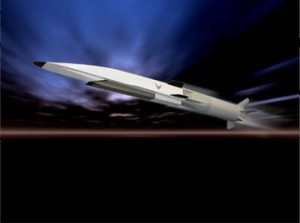
JASC has been awarded a contract to design and develop a novel pressure regulator for use in the X-51A Hypersonic Research Vehicle. This device will provide highly accurate pressure regulation to extremely tight tolerances (less than 1 psi) over the mission – despite the rapidly and widely changing pressure and temperatures at the inlet. This is accomplished via a single-stage in a very compact, lightweight package, through the use of active feedback and integral control electronics.
Initial units will be ready for ground testing of a flight engine in 3Q07, while flight hardware will be delivered during 1Q08.
For more information on this and other high-tech JASC products, please contact us at
engineering@jasc-controls.com.
More information about the X-51A Program.
Printable .pdf version (requires the free Adobe Reader)
Pratt & Whitney Rocketdyne’s Revolutionary Scramjet Engine Successfully Powers First X-51A Simulated Flight Engine using JASC High-Temperature Fuel Valves and JASC High-Pressure Start Control Valve
SJASC provided PWR with the high-temperature (up to 1400 ºF) fuel distribution valves that manage hot fuel delivery to various portions of the scramjet combustor, as well as help pre-condition the fuel.
JASC also supplied the high-pressure blow-down control valve that meters a gaseous hydrocarbon fuel to the engine to initiate combustion.
The valves used in the NASA tests are the penultimate versions of the actual flight hardware, and have proved that the technology employed in these units is successfully implemented and is ready for flight testing.
Printable .pdf version (requires the free Adobe Reader)
Switching from Gas to Distillate Problem-Free
Over the years, many users purchased gas turbines (GTs) with dual-fuel capability to maximize availability—or so they thought. Most of those machines were designed to operate either on natural gas or distillate oil, thereby providing owner/operators some measure of protection against fuel supply disruptions and price volatility. However, users often found the operation of dual-fuel systems problematic and many either decommissioned or removed their liquid fuel systems altogether.
Those who have retained the capability to burn oil on an intermittent basis typically are dealing with annual refurbishment or replacement of OEM- supplied liquid-fuel check valves and flow dividers, according to Schuyler McElrath (smcelr8176@aol.com), a specialist in GT auxiliaries with more than a quarter century of experience troubleshooting fuel-system problems on frame engines for a major OEM.