
JASC News
Practical, Affordable and Effective Solutions for Obtaining Dual Fuel Gas Turbine Reliability
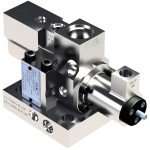
 The Water Cooled 3-Way Purge Valve and Smart Fluid Monitor address the gas turbine industries’ need for practical, cost-effective solutions to enhance the reliability of their power plants. The ability to operate on back-up liquid fuel is achieved via the Water Cooled 3-way Purge Valve. The Smart Fluid Monitor provides monitoring and protection for the cooling water circuits with minimal purchase and installation cost.
Background and Challenges
With the introduction of active cooling for the gas turbine back-up liquid fuel system, dual fuel gas turbine operational performance relative to start-up, transfer and shutdown has never been better.
Active cooling was first installed on a turbine during the fall of 2004, followed shortly by approximately another 120 turbines being outfitted with water cooled liquid fuel check valves. These systems typically experience transfer success rates of 100%, regardless of machine type, climate or operating schedule.
Equally important is the fact that these turbine owners have the luxury of refurbishing their valves at major service intervals such as hot gas path inspections.
JASC identified and addressed two main problems with turbines that were candidates for liquid fuel system upgrades:
- Upgrading existing fuel system hardware to improve reliability is cost and time prohibitive if the new hardware isn’t a bolt-in replacement.
- A system designed for decades of operation needed protection / monitoring of water cooling circuits for both the fuel controls and flame detectors
Download this article in PDF format
Many gas turbines purchased since 2000 have 3-way purge valves installed on the back-up liquid fuel system. Unfortunately, operational reliability for this design suffers over time for the same reason as did standard liquid fuel check valves: high temperatures cause coke formation on the valves’ internal components and degrade sealing capability. Once this occurs, refurbishment is needed in order to address the problem. The process is then repeated after every 12 to 18 months of gas fuel operation.
Previously, if a power plant which utilized the 3-way purge valve needed to improve the reliability of their backup liquid fuel system, they would have to convert to water cooled liquid fuel check valves, purge air check valves, and install cooling water piping in order to achieve this goal. This change is significant from a cost perspective because it means that the fuel and purge air piping must be modified to accept check valves. In many cases, two weeks or more of labor is required to complete this system upgrade. After having evaluated this situation, it became clear that developing a Water Cooled 3-Way Purge Valve would provide an equally effective yet less expensive alternative.
Solution
JASC has developed two new products to further enhance the gas turbine owner’s experience with this technology. Both the Water Cooled 3-Way Purge Valve and Smart Fluid Monitor have been created to provide inexpensive yet effective options for gas turbine owners who are looking for back-up liquid fuel system reliability.
Water Cooled 3-Way Purge Valve: a cost and time-effective solution to implementing a water-cooled system
Design
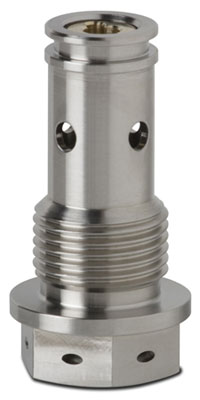
By changing the combustor housing and mounting flange of the standard 3-way purge valve, JASC designed a water cooled version which meets all design goals. With water cooling, the gas turbine owner seeking reliability improvement can now enjoy the same benefits as a turbine owner whose machine is equipped with standard liquid fuel check valves that have been upgraded to water cooled liquid fuel check valves.
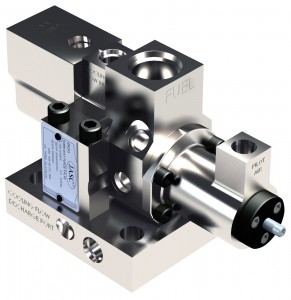 Conversion from a standard configured fuel system to a water cooled variation can be completed in less than two days with the Water Cooled 3-Way Purge Valve. Fuel, purge air, instrument air and valve mounting connections remain the same. The water supply and return manifolds which are fabricated from 1 inch tubing, and tap into the main cooling water supply and return piping, can typically be installed in less than a day.
Upgrading
There are several options available for obtaining the Water Cooled 3-Way Purge Valve. While the most obvious option is the purchase of a new set from JASC, the second option offers the most significant opportunities for savings. Existing 3-way purge valves can be returned to JASC and upgraded to the water cooled version during refurbishment for a fraction of the cost of new valves.
Performance
Testing at JASC of Water Cooled 3-Way Purge Valves using pure air temperatures of 300°F, ambient temperatures of 450°F and cooling water temperatures of 150°F demonstrated that cooling water effectively eliminates coke formation on the valve internal components, including seals. With such promising results we are confident this design will also be able to match water cooled liquid fuel check valves and also operate from hot gas path inspection to hot gas path inspection with no maintenance or service.
Smart Fluid Monitor: providing protection and monitoring of water cooled fuel controls or flame detectors
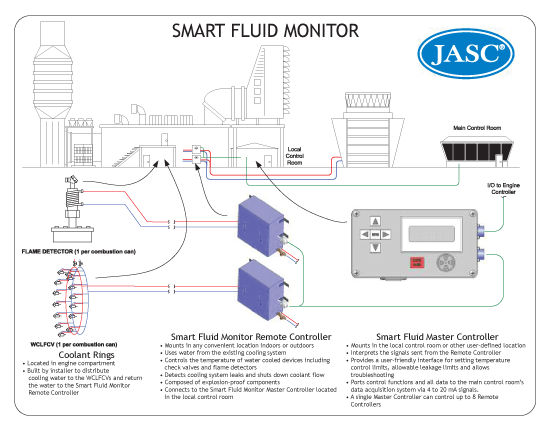
The Smart Fluid Monitor automatically monitors cooling water flow, temperature and leakage. It prevents coking and waxing of water-cooled fuel components, eliminates condensation on flame detectors and prevents damage to industrial gas turbine engines from cooling system water leaks. The Smart Fluid Monitor is capable of operating several remote units on a turbine engine simultaneously. The multifunctional controller monitors water flow within user-adjustable limits and provides water system shut off with an audible alarm should a flow discrepancy of 0.1 gpm or higher occur in cooling water circuits.
System Implementation
Due to the wide variety of turbines and auxiliary systems in use around the world, JASC understands that each site requires an individual evaluation. Contact Schuyler McElrath from JASC today at 1-602-438-4400 to find out how these designs can be used to mitigate your toughest problems.
Boeing 787 Arrives in Phoenix for Hot Weather Flight Testing
Boeing 787 Boeing’s new 787 Dreamliner arrived at Phoenix Mesa Gateway Airport on Saturday, May 22, for hot weather flight testing. Jansen’s Aircraft Systems Controls (JASC) of Tempe, Arizona, manufactures the flow divider used to control fuel flow to the aircraft’s auxiliary power unit (APU). The flow divider’s small size, measuring approximately one-by-two inches, belies its importance on this large aircraft — providing the necessary fuel flow distribution to the APU without a large increase in fuel-system pressure. The APU supplies the aircraft with electrical power on the ground as well as back-up power in flight.
JASC is a manufacturer of advanced fluid controls and actuators for aviation, aerospace and power generation industries. For more information, www.jasc-controls.com.
JASC Celebrates Quality Milestone
JASC celebrated a milestone today as the company’s quality assurance department logged the intake of its 10,000th lot of parts. The logbook was inaugurated in August 2003 as part of the JASC’s quality management system. Since that time nearly 1.9 million parts have been received. As a testament to the value of JASC’s quality control procedures and system, a 98.6% acceptance rate has been achieved.
Two of JASC’s quality personnel, Santiago Castro and Demian Lozano-Phillips are veterans of Marine Corps Squadron VMF-214 Blacksheep, and they helped the company celebrate with a cake cutting ceremony. The first piece of cake was given to JASC’s first employee (and founder) Harvey Jansen. The second piece was passed to the newest employee, Alex Garfio, signifying the passing of experience and knowledge from the old to the young and emphasizing the fact that we care for our newest employees as well as our future before we look to our own needs.
JASC thanks all of its valued suppliers for their support in providing consistent, quality materials.
JASC Announces New Alliances
Global Energy Technologies Limited (GETL) and Osborne Engineering Limited with subsidiary Turbo Power Services (TPS) have been appointed as an authorized distributor and service representatives for JASC industrial gas turbine products.
UAE-based GETL will cover territories in the Middle East and North Africa. In addition to component sales, GETL will provide on-site installation/commissioning support, repair, and overhaul services for JASC products.
UK-based TPS will cover territories in Europe. In addition to component sales, TPS will provide on-site installation/commissioning support, repair, and overhaul services for JASC products.
JASC specializes in the design and manufacturing of new technology for process control problems in industrial, aerospace, and aviation applications. For more information on JASC products and services, go to www.jasc-controls.com.
JASC presents at the annual AIAA Joint Propulsion Conference
JASC once again attended the American Institute of Aeronautics and Astronautics (AIAA) Joint Propulsion Conference (JPC) that was held in Hartford, CT this year.
The aim of this year’s conference was “… to identify and highlight the propulsion systems, components, and technologies required to enable the next generation of aerospace vehicles.” The focus of these technologies includes civilian and commercial aerospace applications, supersonic and hypersonic propulsion research as well as the newly emerging commercial space field.
For the second consecutive year, JASC had a booth amongst some of the propulsion industry’s giants that also attended the conference, including UTC (with both their Pratt & Whitney and Hamilton-Sundstrand divisions), GE Aviation, Rolls-Royce and Aerojet.

JASC’s booth this year proudly displayed some of our more technologically innovative design solutions. These included: our Bi-Propellant Thrust Control Valve (a cryogenic, turbo-pump throttling valve for a commercial space application), our Thrust Vector Control and Fin Control System actuators (also for commercial space applications), as well as an example of our Electronic Pressure Regulator and Hot Gas Valve (the fuel metering valve for the X-51A SED/Waverider hypersonic scramjet research vehicle, currently scheduled to fly in the first half of 2009).
Not only did JASC have a booth at this year’s conference, but JASC is also proud to commend two of our engineers who presented papers. JASC’s engineering manager, John Calleja, presented a paper on the development of our innovative Electronic Pressure Regulator. As mentioned above, this device is used on the X-51A SED/Waverider hypersonic scramjet research vehicle, its function is to control (to a very high degree of accuracy) the pressure of the gaseous nitrogen inside the vehicle’s fuel tank. John’s presentation was well received and sparked quite a bit of interest by those who attended.
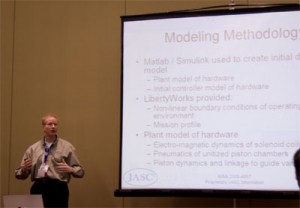
JASC Controls Engineer, Matt Caspermeyer, presented his paper on the modeling and analysis of a high-temperature, pneumatic actuator. Matt’s modeling was used to verify the intended performance of a pneumatic actuator designed to control the Inlet Guide Vanes and First Stage Stator of a technology demonstrator turbine engine. Through Matt’s excellent analytical and modeling skills, he was able to identify a performance deficiency before any hardware was machined. This allowed a redesign of a critical section within the actuator, resulting in a complete actuator system (control valve, a pneumatic actuator, and digital electronic controller) that worked the first time it was tested. Matt’s presentation was well attended and also piqued quite a bit of interest.
If you have any questions or would like to know more about any of the items mentioned above (or any other innovative JASC designs) please visit our website: www.jasc-controls.com.
If you’re ever in the Phoenix area, please stop by and visit our facility.
Printable .pdf version (requires the free Adobe Reader)