
2018 News Archives
Experience Increased Operating Intervals Between Liquid Fuel Runs with JASC’s Water Cooling Technology
Abstract from CCJ Onsite Combined Cycle Journal – June 27, 2018:
Reliable operation of dual-fuel gas turbines on oil demands that owner/operators protect against coking of distillate in fuel-system components. Active cooling is one solution available to users for assuring both reliable starts on liquid fuel and reliable fuel transfers from gas to oil.
Recall that stagnant fuel in supply lines not protected against heat radiated from the gas-turbine casing transitions to solid coke over time. In earlier stages of the coking process a tar-like substance is created that fouls check valves, coats fuel-nozzle passages, and builds up on the inside surface of oil piping. Case in point: Key components of liquid-fuel systems on many dual-fuel 7FA gas turbines are located in a 500F environment, double the nominal 250F temperature at which coking of distillate begins.
JASC, Tempe, Ariz, has been at the forefront of industry efforts to improve the reliability of liquid fuel systems for well over a decade. The company’s subject-matter expert, Schuyler McElrath, told the editors, “Active cooling of the fuel supply system has been a fundamental component of our technology and has demonstrated the ability to improve reliability.”
JASC Products used for active cooling of the fuel supply include:
- JASC’s All-New Heatsink Clamps
- JASC’s Water-Cooled 3-Way Purge Valve
- JASC’s Water-Cooled Liquid Fuel Check Valve
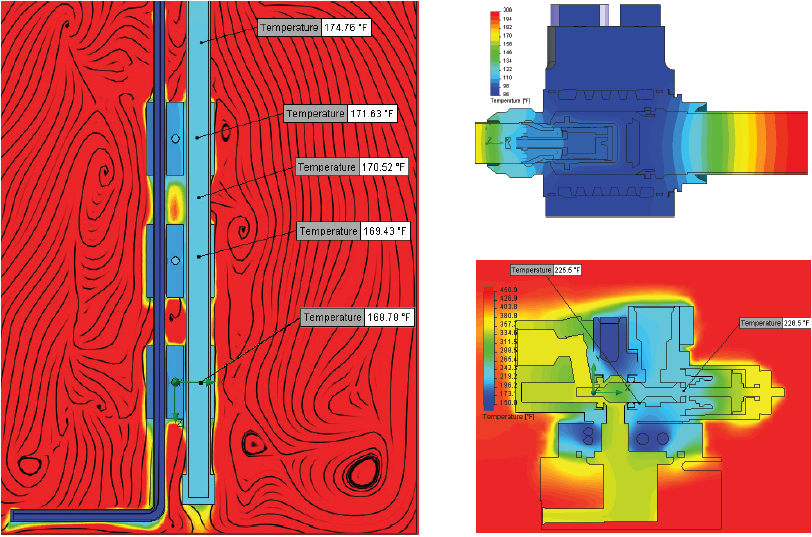
Thermal analysis shows the effectiveness of active cooling (Left: Fuel lines with heat-sink clamps installed, Top Right: Water-cooled liquid fuel check valve, and Lower Right: Water-cooled 3-way purge valve.)
JASC System Performance Examples
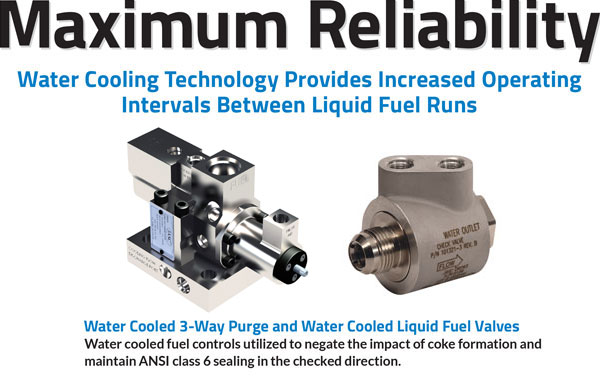
In one case, JASC Water Cooled Liquid Fuel Check Valves have operated on two 7F dual fuel machines for almost two years without issue. Operation on liquid fuel was only performed when required, not to exercise the system.
A second set of four DLN 7EA turbines outfitted with JASC Water Cooled 3-Way Purge Valves have operated since November of 2013 without a valve failure. While only one set of valves have been removed for service, due to a scheduled C.I., the turbine successfully performed 23 of 25 fast starts over this four year period. (Note: the customer insulated fuel piping on this application as Heatsink Clamps were invented in 2016).
Next, seven 7FA’s were upgraded to JASC Water Cooled 3-Way Purge Valves during 2017, with a total of six completed in December of 2017. Four of these turbines have accumulated in excess 7000 hours of operation on gas and approximately 300 hours of operation on liquid fuel over a three month period. A set of 14 valves removed from one of these turbines, for a C.I., were described by the customer as looking brand new. The difference in performance is profound. In a previous application, before the implementation of JASC Heatsink Clamps, six weeks of operation on natural gas was long enough to degrade stagnant liquid fuel to the point where its viscosity was the consistency of tar and attempts to burn fuel would result in high exhaust temperature spreads, flame out and exhaust temperature trips.
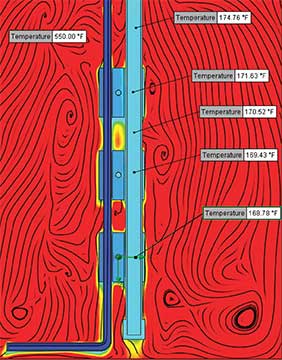
CFD analysis shows how effective active cooling can be. This example demonstrates the results when the coolant temperature is 120°F and the test oven set for 550°F. All temperatures in the simulated liquid fuel line are well below the coking temperature.
The limits of gas operation for JASC Heatsink Clamps has not been determined at this point. CFD data suggests that fuel should remain pristine over significantly long periods of time. Given that one of our latest installations will not run on liquid fuel unless called upon, we anticipate that our customer will run strictly on natural gas for the next six months of their summer season.