2000 – 2011 News Archives
Back to the Future, Part Two! Meet the X-43A Scramjet!
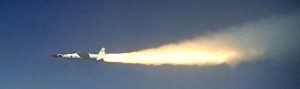
Hyper-X Vehicle X-43A
On November 16th, 2004, Jansen’s Aircraft Systems Controls (JASC), proudly participated in a major milestone for the aerospace community as the Hyper-X Research Vehicle (X-43A) streaked out over the Pacific Ocean at nearly 10 times the speed of sound. After getting a ride from a B-52 to 40,000 feet, the Pegasus booster rocket accelerated the 12-foot-long unmanned X-43A supersonic combustion scramjet vehicle from Mach 0.6 to a speed close to Mach 10. At an altitude of 110,000 feet, the test vehicle traveled at a speed of nearly 7,000 mph (approximately Mach 9.8).
This accomplishment is truly a milestone for the aeronautics community – and the world. It is the second time that an airframe-integrated scramjet (supersonic combustion ramjet) engine was demonstrated in free flight. The initial successful flight, in which JASC also participated, occurred on March 27th, 2004, where the test vehicle flew at a speed of Mach 7 at an altitude of 95,000 feet.
JASC designed and developed the electromechanically-actuated, electronically-controlled ignitor and fuel control valves for the scramjet engine. After the vehicle was jettisoned from the booster and achieved stable flight at nearly Mach 9.8, the vehicle’s engine cowl door opened, allowing air into the engine. The JASC silane ignitor valve was then actuated, followed by the JASC hydrogen fuel valve to sustain and regulate combustion in a process analogous to lighting and keeping a match lit in a hurricane!
The two successful flights were the culmination of over 40 years of effort to demonstrate successful air-breathing hypersonic flight. This is proclaimed to be “the Holy Grail of Flight” by veterans in the aerospace engine community. Both of these X-43A flights superseded the previous record-holding air-breathing engine flight of Mach 3+ by the SR-71 Blackbird and eclipses the X-15 record of Mach 6.7 which used a rocket-powered engine.
In addition to the X-43A fuel control effort, JASC is pioneering the development of high temperature, hydraulically actuated control valves that will allow hydrocarbon fuels to be used in scramjet combustors. The ultimate benefit lies in allowing for low cost, repetitive, high-speed flights for both military and commercial purposes.
JASC founder and president, Harv Jansen, is a true aerospace industry pioneer. He was involved as an engineer on the development of the SR-71’s J-58 engine and the world’s first liquid hydrogen/liquid oxygen rocket engine designated the RL-10. The J-58 engine was as innovative as the SR-71 airframe. To this day, the J-58 remains a state of the art engine in aircraft propulsion. It was the first and only dual-cycle aircraft engine, transitioning from a conventional turbine engine to a ramjet engine at ~Mach 2. It was the first engine to use fueldraulic controls, and the first to use metal seals on tubing joints. Many materials and fluid advancements in use today were spawned from the J-58 engine development program.
More Information: Dryden Flight Research.
Printable .pdf version (requires the free Adobe Reader)
JASC Obtains ISO Registration
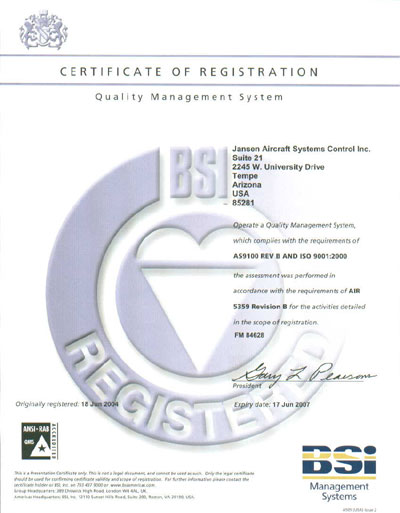
JASC, Inc., located at 2245 W. University Drive, Ste. 21 in Tempe, Arizona, has become registered to ISO9001:2000 and AS9100, Rev. B. The registration is effective June 18th, 2004.
JASC employs some 25 personnel providing customer satisfaction through total program management of OEM products. The company has been in business since 1991.
“We wanted to implement a system to improve our internal processes as well as become more attractive to our customer base, which allows us to become a supplier of choice,” states JASC President and CEO Harvey Jansen. “We feel that ISO and AS9100 registration is key to the company’s future success.”
Jansen’s Aircraft Systems Controls, Inc. designs, manufactures, and repairs engine fuel controls, servo valves, servo actuators, and various fluid control components for aerospace, commercial, and industrial applications.
Printable .pdf version (requires the free Adobe Reader)
JASC Delivers Active Combustion Control Valves to GEAE
On May 1, 2004, JASC delivered their Active Combustion Control Valve to General Electric Aircraft Engines. This system will be integrated into GEAE’s fuel system for use with an experimental lean-burn liquid fuel turbine engine in an effort to control and suppress combustion instabilities that may exist in the engine’s combustor.
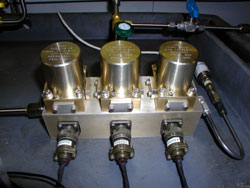
Active Combustion Control Valve
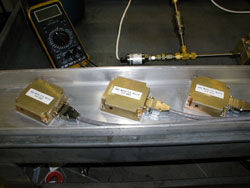
Amplifier/Drivers for ACCV
At the heart of the system are three of JASC’s patented High-Speed Servo Valves (HSSV’s), which have demonstrated response within 5 dB to 550 Hz and within 10 dB to 600 Hz using liquid fuel in laboratory testing at JASC.
GEAE plans to evaluate the system on their test rig throughout the month of May 2004.
Printable .pdf version (requires the free Adobe Reader)
Fastest Fuel In The West
A 14-year old Tempe aerospace company has found a lucrative niche for itself making high-tech controls for engine fuel systems.
Back To The Future: JASC and the Mach-7 Launch of the NASA Hyper-X Scramjet
Jansen’s Aircraft Systems Controls (JASC) proudly participated in a major milestone for the aerospace community as the Hyper-X Research Vehicle (X-43A) streaked out over the Pacific Ocean at a record-breaking speed of Mach 7 (over 4700 mph). NASA Dryden Flight Research Center reported that on the afternoon of March 27th, 2004, after getting a ride from a B-52 to 40,000 ft and then a Pegasus booster rocket to Mach 7 at 95,000 ft, the Hyper-X engine fired and history was made.
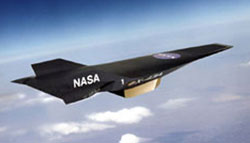
NASA Hyper-X Research Vehicle (X-43A)
It is the first time that an airframe-integrated scramjet (supersonic combustion ramjet) engine was demonstrated in free flight. In addition, preliminary data suggest that a net positive thrust was achieved. This accomplishment is truly a milestone for the aeronautics community – and the world.
JASC designed and developed the electromechanically-actuated, electronically-controlled ignitor and fuel control valves for the scramjet engine. After the vehicle was jettisoned from the booster and achieved stable flight at Mach 7, the vehicle’s engine cowl door opened, allowing air into the engine. The JASC silane ignitor valve was then actuated, followed by the JASC hydrogen fuel valve to sustain and regulate combustion in a process analogous to lighting and keeping a match lit in a hurricane!
Larry Huebner, the NASA Langley Research Center Hyper-X propulsion lead stated, “We achieved positive acceleration of the vehicle while we were climbing, and maintained outstanding vehicle control. This was a world-record speed for air-breathing flight.”
The flight was the culmination of over 40 years of effort to demonstrate successful positive thrust hypersonic flight, proclaimed to be “the Holy Grail of Flight” by veterans in the aerospace engine community.
The record-breaking X-43A flight supersedes the previous record-holding air-breathing engine flight of Mach 3+ by the SR-71 Blackbird and eclipses the X-15 record of Mach 6.7 which used a rocket-powered engine.
In addition to the X-43A fuel control effort, JASC is pioneering the development of high temperature, fuel-draulically actuated control valves that will allow hydrocarbon fuels to be used in scramjet combustors. The ultimate benefit lies in allowing for low cost, repetitive, high-speed flights for both military and commercial purposes.
Need for Speed / Speed for Freedom: Airbreathing hypersonic engines will someday allow for reusable vehicles for access to space; rapid global flight for commerce; and high-speed deployment of munitions to defend our country.
JASC is committed to assisting our Customers in making affordable hypersonic flight a reality.
JASC founder and president, Harv Jansen, is a true aerospace industry pioneer. He was involved as an engineer on the development of the SR-71’s J-58 engine and the world’s first liquid hydrogen/liquid oxygen rocket engine designated the RL-10. The J-58 engine was as innovative as the SR-71 airframe. To this day, the J-58 remains a state of the art engine in aircraft propulsion. It was the first and only dual-cycle aircraft engine, transitioning from a conventional turbine engine to a ramjet engine at ~Mach 2. It was the first engine to use fueldraulic controls, and the first to use metal seals on tubing joints. Many materials and fluid advancements in use today were spawned from the J-58 engine development program.
Observing the first true hypersonic flight by the X-43A was especially gratifying for the JASC Team. We truly hope that there are many more to come.
Printable .pdf version (requires the free Adobe Reader)