
2000 – 2011 News Archives
JASC Reaches 40,000 Unit Milestone on Industrial Valves
JASC is pleased to announce a shipping milestone for industrial power generation products! Over the past five (5) years, JASC has manufactured and shipped liquid fuel check valves, purge air check valves and three-way purge valves for use on heavy-duty gas turbine engines used in power generation.
Breakdown of these industrial products:
Liquid Fuel Check Valves = 25,000
Purge Air Check Valves = 12,000
Three-Way Purge Valves = 3,000
40,000 units
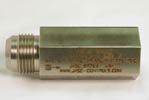 JASC’s High-Flow, Zero-Leak Liquid Fuel Check Valves are designed to operate with fluids including Stoddard solvent, jet fuels, hydraulic oil, and synthetic oil. Fluid damping is used to provide stable operation from crack to full flow operation.
 JASC’s Purge Air Check Valve units are designed to operate continuously on a gas turbine engine with air temperature in excess of 400° F in the free flow direction and with liquid fuel, up to 1200 PSID and 250° F in the checked direction. These units will also operate on water, Stoddard solvent, jet fuel, diesel fuel, hydraulic oil, and synthetic oil.
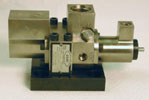 JASC’s Three-Way Purge Valve offers a means to deliver fuel or purge air to the combustion chamber atomizers of a gas turbine engine. The valve operates at high pressure and temperature while maintaining zero leakage between individual air and fuel sources.
Printable .pdf version (requires the free Adobe Reader)
JASC Receives Order for its Active Combustion Control Valve
In January 2004, JASC was awarded an order to supply General Electric Aircraft Engines with a version of their high-speed servo valve (HSSV). This valve is an application used to control combustion instability in one of GEAE’s experimental lean-burn gas combustors. Several of these HSSV’s will be used to comprise the JASC Active Combustion Control Valve (ACCV) that will ultimately be integrated into the GEAE test engine’s fuel control system. Testing of the ACCV system is scheduled to begin 1Q04.
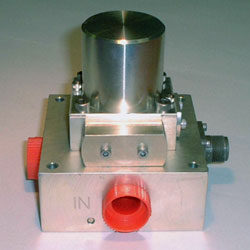
JASC HSSV for the Active Combustion Control Valve
A similar Active Combustion Control Valve has been developed by JASC to attenuate undesirable pressure pulses within the combustion chamber of a turbine engine. This unit has successfully operated at 400 HZ in a gas turbine combustion chamber test rig.
For more information on the state-of-the-art technology that JASC produces, please contact us by phone at 602.438.4400, e-mail at engineering@jasc-controls.com.
Printable .pdf version (requires the free Adobe Reader)
JASC Delivers GDE-2.0 Hot Gas Valves to Pratt & Whitney
On August 22, 2003, JASC, Inc. completed performance verification testing of three five-channel hot fuel control valve arrays slated for use on the Ground Demonstration Engine V2.0 (GDE-2.0) later this year, with Pratt & Whitney taking delivery of the valves the following week. These Hot Gas Valves (HGVs) form an integral part of the scramjet engine’s fuel control system, which will be used to precisely control the flow of high-temperature, gaseous hydrocarbon fuel to various regions of the engine’s combustor.
This engine will be tested in the NASA LaRC 8-ft High-Temperature Tunnel (HTT), which will provide data to further define critical engine operating parameters, fine-tune the engine’s thermal management system, and validate CFD analysis for the full-height and width, single module, flight-weight engine. This engine is the penultimate version of the one envisioned to power the X-43C Hypersonic Research Vehicle, scheduled to make its maiden flight in CY06.

An artist’s rendering of the air-breathing, hypersonic X-43C, part of NASA’s Hyper-X series of flight demonstrators. CREDIT: Media Fusion, Inc./NASA
All valves performed flawlessly during ambient temperature testing at JASC, and exceeded all performance requirements for dynamic response, metering accuracy, repeatability, and sealing. Proof pressure testing was performed at levels simulating actual worst-case loading conditions at the design temperature & pressure. Valve testing with high-temperature fuel is scheduled for this fall, after which the valves will be installed on the engine. Engine testing in the 8’HTT is scheduled to occur during Q1-04.
The program is being funded through the Air Force’s Hydrocarbon Scramjet Engine Technology (HySET) Program, under the broader Hypersonic Technology (HyTECH)
Program. The engine will ultimately operate in the Mach 4.5-6.5 range and has both military and commercial applications.
Printable .pdf version (requires the free Adobe Reader)
JASC awarded Fuel Control System and Inlet Guide Vane Actuator for the Airbus A-380 APU
In July 2003, JASC was awarded a contract from Hamilton Sundstrand, of San Diego, CA, to develop the Fuel Control System and Inlet Guide Vane Actuator for the PW-980. The PW-980 is the Auxiliary Power Unit (APU) that will be used on the Airbus A-380 (seen below). The A-380 is a next-generation Jumbo Jet, designed to carry 555 passengers over 8,000 nautical miles.
The largest commercial APU currently available is the PW-901, found on the Boeing 747-400 series aircraft. The PW-980 is a larger derivative of the original PW-901 design and will assume the role as the largest commercial APU when it enters service on the A-380 (scheduled for 2006).

The PW-980 APU, to be used on the Airbus A-380, will be equipped with a Fuel Control System and Inlet Guide Vane Actuator developed by JASC
Control systems are not new to JASC. The company has been developing a wide variety of controls and has over 40 years of experience in the field. From small UAVs (see the article “Mini-Motors to Drive Small UAVs, Missiles” in the July 29, 2002 issue of Aviation Week & Space Technology), to large industrial power applications, JASC is a proven name in fuel controls.
JASC is also establishing itself as the leader in fuel controls for hypersonic research aircraft. It has developed the fuel controls for the X-43A (Hyper-X) vehicle, as well as follow on engine/vehicles (see the articles “Component Tests Aid Scramjet Development and Flight-Weight Scramjet Readied for Tests” in the June 24, 2002 issue of Aviation Week & Space Technology).
Printable .pdf version (requires the free Adobe Reader)
JASC Ships First PWM Fuel Control Valve destined for use on DARPA’s Micro UAV’s
JASC is pleased to announce the completion and shipment of our Pulse Width Modulated (PWM) Fuel Control Valve. This valve is used to meter fuel to small compression ignition engines. Target applications for this valve include the engines used to power the developing field micro UAV/drone aircraft for the U.S. armed forces. These drones weigh about five pounds, measure about nine inches in diameter and are designed to fit inside a soldiers backpack. These drones are intended to be part of an autonomous aircraft and ground vehicle network that will perform a wide range of military missions. The Micro UAV’s can carry small cameras and may be used to fly “over the next hill” to perform reconnaissance
for other robotic or manned units (1).
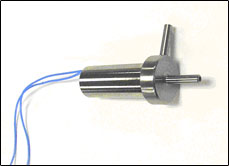
The PWM Fuel Control Valve meters fuel flow and provides positive fuel shutoff for either diesel or JP-8 by using a modest fuel tank head pressure as the motive force. The PWM Fuel Control Valve is operated by a PWM signal from an electronic fuel management computer. The fuel-metering schedule is a function of duty cycle at a fixed frequency, as commanded by the electronic fuel management computer. This design provides for a low cost, small and lightweight fuel metering valve for small engines and is based upon existing JASC technology for “clapper type” fast-response solenoid valves.
The Pulse Width Modulated Fuel Control Valve is another example that demonstrates JASC’s capabilities in designing innovative flow control devices to fit a wide range of applications. For a detailed list of the products that JASC currently manufactures, please visit the Products page.
PWM Fuel Control Valve operating characteristics:
- Input Signal: 5.0 ± .5 VDC @ 30 HZ
- Duty Cycle: 12% to 75% range
- Max. Current: .50 amps.
- Flow: 0.2 to 2.0 PPH @ 10 inches of head pressure
- Seat Leakage: Zero
- Temp. Range: -65 to +350 °F
- Dry Weight: 2.0 oz. Max.
- Dimensions: 0.500” F X 1.500” length max.
(1) Popular Science Magazine, June 2003.
Printable .pdf version (requires the free Adobe Reader)