2017 News Archives
Liquid Fuel System Operational Capability: THE NEW REALITY
The new reality for gas turbine owners, as it relates to long term operational capability, is that a JASC solution has achieved another significant milestone in the industry. Specifically, while turbine owners have long enjoyed the benefits of a greatly improved liquid fuel system by replacing existing hardware with JASC designs, our latest product developments address another factor which is of critical importance, reduction of annual fuel costs.
In order to mitigate customer concerns about fuel costs associated with needing to regularly burn liquid fuel in the turbine in order to maintain reliability, JASC has developed and incorporated new hardware. The “thermal clamp” is the latest design to complement our comprehensive design philosophy. This device drastically reduces how often a turbine is required to burn diesel in order to maintain or verify component and system integrity. The thermal clamp is a very simple, elegant and inexpensive design that has proven to be a great addition to the JASC product line. While turbines typically need to run at least once a month, thermal clamps have drastically increased this interval. The resultant savings for fuel were approximately $330,000 for one 7F turbine over the course of one year, with no degradation of reliability.
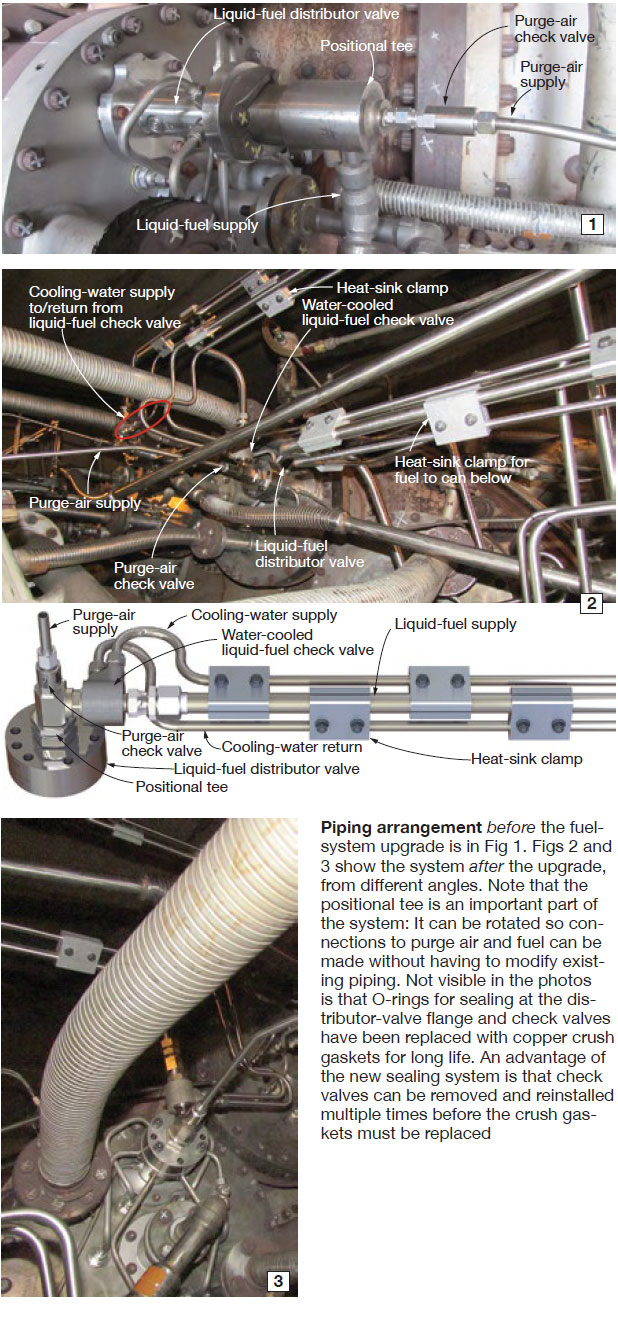
Mouse over the image below to see details of a design configuration using JASC’s heat sink thermal clamps, purge air valve, swivel tee, flange, and water cooled liquid fuel check valve.
[heatsink]
In our first test of the thermal clamp, two peaking 7F turbines were outfitted with JASC’s complete design configuration. Thermal clamps, water cooled liquid fuel check valves, purge air check valves, positional tees, Smart Fluid Monitors, thermal relief valves and copper crush gaskets were all applied to this installation. The results after 15+ months of operation have been phenomenal.
These turbines, which were run on liquid fuel during system commissioning, have operated almost exclusively on natural gas since the upgrades were completed in April of 2016. The first run on liquid fuel occurred in January of 2017, fully nine months after the test run. Both turbines were operated without incident. The second documented run on liquid fuel occurred when scheduled emission tests were performed during the summer of 2017. Based on the information we received, a total of two liquid fuel runs occurred over a period of 15 months, with no loss of system integrity.
Finally, additional testing, which incorporates thermal clamps with JASC’s water cooled 3-way purge valves, is currently underway. Results should be available for publication in May of 2018. JASC expects to set new standards for reliability from this application as well. Thermal clamps’ ability to eliminate heat-related viscosity changes to stagnant diesel in fuel supply lines along with other innovative JASC designs add another level of performance to our system configurations. No maintenance or service until a major turbine service interval is reached, minimal need to exercise the liquid fuel system and significant reduction of fuel costs all provide for a better gas turbine owner experience relative to both reliability and cost.
Read More About the Benefits of JASC’s Thermal Clamps
Thermal clamps help prevent coking in gas turbine liquid-fuel lines
Thermal Clamps Help Prevent Coking in Gas Turbine Liquid-Fuel Lines
This article by JASC was recently featured in the Combined Cycle Journal, Number 53, Second Quarter. Read the article below or right click to download it here.
Reliable operation of dual-fuel gas turbines on oil demands that owner/operators protect against coking of oil in fuel-system valves and piping. Active cooling is one solution available to users for assuring both reliable starts on liquid fuel and reliable fuel transfers from gas to oil.
“Cool valves, piping improve engine reliability when called to burn oil,” CCJ 1Q/2016 (p 69) and available at www.ccj-online.com (type headline into the search-function box), discusses several cooling options offered by JASC. One of these, the so-called “thermal clamp,” was introduced as that article was in preparation.
Early results available from the first commercial installation (Fig 1, before; Figs 2 and 3, after point to success both in protecting against coking and eliminating the need for “verification” firing of oil monthly to confirm liquid-fuel system reliability.
JASC’s (Tempe, Ariz) Schuyler McElrath told the editors, “With our latest system configuration consisting of rerouting fuel piping, incorporation of heat-sink clamps to keep fuel lines cool, water-cooled fuel controls, and component connections which don’t use O-rings, we are now offering the capability of running on liquid fuel at semi-annual intervals, or longer, without sacrificing back-up liquid-fuel system reliability.
“In the first test of this latest configuration, the second of two 7F gas turbines operated on liquid fuel during commissioning of the fuel-system upgrade in April 2016. The site operated exclusively on natural gas over the next nine months, burning oil only during the second week of January 2017. The next run on liquid fuel was in July 2017. Both times, the turbines started and operated on liquid fuel without incident.”
Thus the two-unit site burned liquid fuel successfully twice in the 15-month period ending in July. The typical site needing to confirm oil firing capability on two units would have paid approximately $60,000 each month the test was conducted. Thus, not having to run tests for 13 of the 15 months since the upgrade was completed saved more than three-quarters of a million dollars.
Based on this success, the owners of other sites currently are upgrading the fuel systems on some of their 7FA engines. These particular upgrades present a variation on the original concept in that they will be using JASC water-cooled 3-way purge valves to replace either standard 3-way purge valves or check-valve and purge-air valve configurations. Piping modifications highlighted here will be incorporated.