
Posts by JASC Controls
Valves & Actuators: The Path to Greater Efficiency & Performance
JASC was featured in Power Engineering’s April 2014 publication, discussing innovative applications and design modifications that have lead to improvements in actuator technology, reducing costs and providing better performance for high-pressure steam bypass, turbine bypass, and other critical power plant operations.
Read JASC’s contribution to the article below.
Over time, there may not be another auxiliary system more maligned than that of a back-up liquid fuel system on a dual fuel gas turbine. The hardware shortcomings responsible for the inability to start on liquid fuel or transfer from gas to liquid fuel, check valve failures, flow divider failures, fuel system evacuation, exhaust temperature spreads, and related turbine trips have all been addressed by designs developed by JASC Controls. Water cooled check valves, which prevent carbonization, metal to metal sealed water injection check valves rated for service at 750 degrees “F”, multiple use crush gasket technology which replace o-rings with a 1000 degree “F” rating at 2000 psi and a Zero Emissions Equipment design which allows a turbine owner to test the readiness of the liquid fuel system without firing on oil are examples of the JASC’s unique technology.
These system specific products have two common design goals. First, they provide reliable operation for at least 32,000 hours or until a scheduled turbine service interval is reached. This provides the optimal timing for returning the valves to the JASC facility for refurbishment after three or four years of use.
Second, the valves must maintain an ANSI Class 6 sealing capability from installation until removal for refurbishment. Elimination of reverse flow results in separation between the turbine combustion process and auxiliary systems such as liquid fuel, purge air, and water injection. With no reverse flow of combustion gasses into these systems, back-up fuel system availability and reliability typically exceed 98 percent.
Finally, JASC’s solutions are configured to be interchangeable with the turbines existing hardware. This characteristic both minimizes the cost and reduces the time associated with performing fuel system upgrades on a turbine of any age.
98% Proven Success Rate for Liquid Fuel Transfer From Gas to Oil
Gas turbine engine owners can experience fuel transfer success rates of 98% or greater when employing water cooled valve technology. JASC’s water-cooled liquid fuel check valve has shown that gas turbine owners can operate liquid fuel systems reliably for extended periods of time. This is due to a water-cooled jacket that helps maintain check valve internal temperatures well below the coking threshold. Additionally, through the prevention of coke formation, valves can maintain their ANSI Class 6 seal, which prevents evacuation and fuel leakage into fuel nozzles.
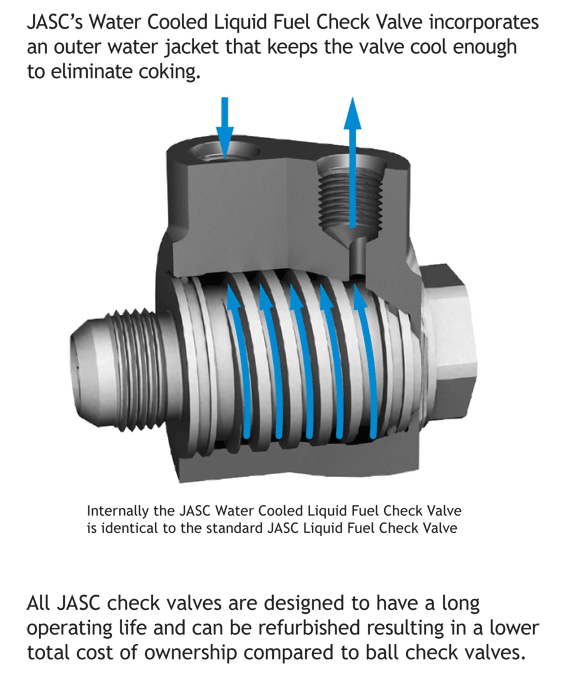
To learn more about the causes of liquid fuel transfer failures and JASC’s revolutionary solution, read below.
Click here to learn more about JASC’s Water Cooled Liquid Fuel Check Valve.
Liquid fuel check valve operation in dual fuel gas turbine applications is exceptionally severe. The impact of both system and related environmental anomalies on liquid fuel check valves lead to both premature failures of the valve and other fuel system components.
Check valve coking, high-frequency oscillation, hydraulic hammer, tubing stress fatigue related failure, flow divider corrosion, fuel nozzle coking, fuel pump failure, magnetic clutch failure, and fuel system evacuation are all problems which result from liquid fuel check valve failures. The resulting reliability issues significantly increase the cost of ownership due to increased maintenance and valve replacement intervals.
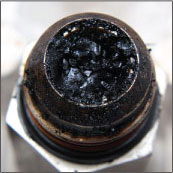
Check valve coking is the first phenomena which will be discussed. The term coking is used to describe carbonization of diesel fuel on the check valve internal components when the turbine is operating on gaseous fuel. During this time, the liquid fuel system is idle and the diesel is stagnant in the check valve. Temperatures of 250 degrees F are typically enough to start the process and are easily achieved in the turbine compartment where the check valves are positioned.
Unfortunately, as diesel fuel becomes older and more unstable, the temperature threshold at which coke forms decreases. An essential characteristic of coke is that once it forms, short of soaking the component in a strong solvent, it does not dissolve. At this point, crack pressure and sealing capability are significantly compromised.
Cracking pressure is defined as the point where check valves are designed to open and allow fuel flow to begin. Sealing ability both prevents diesel fuel from leaking downstream into the combustor and combustion gasses from traveling upstream through the valve into the fuel system. Coke formation inside of the check valve degrades both of these critical parameters.
 As it relates to gas turbine operation, fuel system integrity suffers significantly from the partial or complete evacuation of liquid fuel when leakage exceeds an ANSI Class 6 standard. Symptoms of check valve leakage related failure include but are not limited to: multiple attempts required to achieve turbine ignition on liquid fuel, high exhaust temperature spreads both at start-up or when transferring from turbine operation on gaseous to liquid fuel.
Finally, data collected from gas turbine sites worldwide during the past several years has demonstrated that there is a solution available which mitigates the risk of check valve related failures. The development and use of water-cooled liquid fuel check valves has shown that gas turbine owners can operate liquid fuel systems reliably for extended periods of time.
The benefit is that by maintaining check valve internal temperatures well below the coking threshold, liquid fuel check valve failure is all but eliminated. The ability to prevent coke formation
allows the valve to maintain an ANSI Class 6 seal. This seal prevents fuel system evacuation and fuel leakage past the check valve into the fuel nozzles.
Maintaining a primed liquid fuel system allows all check valves to open at pressures which adhere to specification. The uniform opening of all liquid fuel check valves allows consistent fuel flow to the fuel nozzles. Thus, high exhaust temperature spread related system failures are avoided during turbine ignition on liquid fuel and during fuel transfers. Fuel transfer success rates nominally approach 100% on gas turbines which have implemented water cooled valve technology.
JASC Facility Expansion
August 2012—JASC has launched its facility expansion project. The company is building out its Tempe, AZ headquarters and will provide an additional 8,400 sq. ft. of usable space to the existing 20,000 sq. ft. already in use. The new area will feature engineering development labs, high-pressure pneumatic capability, fuel testing, shock and vibration testing, and an expanded aircraft component assembly space, offering better organization and production workflow.
Equipment is being moved into the new space as the buildout moves toward completion.
JASC Participates At 3rd NASA GRC Propulsion Control And Diagnostics Workshop
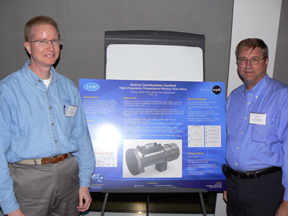
Matt Caspermeyer of JASC and Bill Heatley of O’Miller Associates attended the 3rd NASA GRC PCD Workshop held February 28-March 1, 2012 at the Ohio Aerospace Institute, Cleveland, OH. The workshop covered various aspects of propulsion controls including Enhanced Engine Control, Model-Based Control and Diagnostics, Distributed Engine Control, Industry Perspectives on Propulsion Control Diagnostic Research, Active Combustion Control, and High-Speed Propulsion Modeling and Control.
Matt (on the left) and Bill also participated in a poster presentation describing the JASC Active Combustion Control Valve concept that is currently in a Phase II SBIR. The High-Frequency Proportional Rotary Fuel Valve is designed to mitigate combustion instabilities at higher frequencies than have been previously achieved (~1000Hz) allowing gas turbines to run at operating points that produce lower emissions and higher performance.
JASC Installations – A New Era in Customer Service for Reliability Upgrades
Tempe, AZ—6/16/2011—Jansen’s Aircraft Systems Controls, Inc. (JASC) is pleased to announce the creation of JASC Installations, LLC, a company which specializes in the installation of gas turbine control hardware which significantly enhances both start-up/transfer reliability and operational availability. After having spent many years evaluating both system and component deficiencies which can make system maintenance programs expensive and ineffective, JASC patented a wide range of products specifically for use in liquid fuel, purge air, water injection and flame detector systems. This considerable expertise, which was applied to component design, is now utilized to troubleshoot and resolve system related issues as well. A variety of conditions can be present at any given turbine site. Consequently, the installation of our products is not a guarantee that the desired level of operational capability will be achieved unless all underlying issues are also addressed as part of the process. JASC Installations’ ability to diagnose and correct the cause (s) of issues which negatively impact system performance after fuel system components upgrades have been performed makes it a unique service. Accordingly, JASC Installations is now providing turnkey fuel system upgrades, project management and technical support for liquid fuel system projects of any size or scope. Installation services improve the operational capability of even the most problematic liquid fuel system.
There are a wide range of gas turbine fuel systems being utilized throughout the world, many of which are dual fuel, meaning that they alternate between natural gas and diesel fuel for turbine operation. While significant advances have been made in the electronic control of these fuel media, the hardware remained virtually unchanged for the backup liquid fuel system for decades. JASC developed a variety of products:
- Check valves which use water to cool their internal components preventing diesel fuel from solidifying while the turbine is operating on natural gas.
- Purge air check valves which are capable of sealing to an ANSI class 6 standards (bubble tight) while requiring only 1/2 psi of pressure to open.
- Water injection check valves that provide an ANSI class 6 seal and are not prone to excessive wear due to high-frequency oscillation or chatter.
- Three-way purge valves capable of alternating between purge air and liquid fuel; a water-cooled version of the design prevents solidification of diesel fuel in it as well. JASC Installations provides services which fully integrate these products into an existing system to minimize cost while addressing the fundamental issues impacting reliability.
In this day and time, it is rare that the most effective solution to a problem is also the least expensive. Relative to fuel systems, JASC has accomplished this feat for installation of backup liquid fuel system upgrades, operational reliability and total cost of ownership. Transfer success can be improved from the industry norm of 30% to rates approaching 100%. The formula for success is as straightforward as it is simple. Specifically, provide bolt-in hardware that closely matches the turbine owners’ currently installed configuration to minimize piping changes; design hardware which is capable of making the system in which it is installed operate at levels that approach 100% reliability and availability. Couple these characteristics with savings ranging from $100,000 to $1,000,000 per turbine on installation costs alone and you have an option which warrants consideration in any fuel system upgrade discussion.
For an “F” class gas turbine which utilizes liquid fuel check valves, an upgrade would be about 1/3 the cost of other options. Components supplied for the upgrade would include water-cooled liquid fuel check valves, water injection flow proportioning valves and a Smart Fluid Monitor. The type of purge air valve used would determine whether a JASC designed valve would be required. Savings on installation would be at least $100,000 per turbine. Savings on other models of turbines would be higher.
For an “F” class gas turbine which utilizes three-way purge valves, a fuel system upgrade would be about 1/5 the cost of other options. Required equipment would include water-cooled three-way purge valves, water injection flow proportioning valves and a Smart Fluid Monitor. A gas turbines owner’s savings for an installation would be approximately $1,000,000 per turbine. The significant difference in cost is tied directly to the technology, which is available for this particular configuration.
Finally, after examination of installation cost, material requirements, specifics of component design and total cost of ownership, gas turbine owners will have a great basis for comparison. JASC Installations reliability upgrades for backup liquid fuel systems, like their products, set a new standard for the industry. For more information contact; Sales@jasc-controls.com