
JASC News
Cool It!
Cool it with JASC Water-Cooled Liquid Fuel Check Valves. JASC’s Water-Cooled Liquid Fuel Check Valves have low acquisition cost, ease of installation and have provided a 2,500% reliability improvement in liquid fuel system operations compared to non-water cooled check valves.
JASC Welcomes Seal Tech, Inc.
On Friday, June 3, 2005, Jansen’s Aircraft Systems Controls, Inc was proud to host representatives from the Seal Tech company headquartered in Tokyo, Japan. The four associates traveled across the globe to discuss the JASC product line and how certain items can solve their customer’s needs.
JASC and Seal Tech are looking forward to establishing a long lasting business relationship that will be mutually beneficial.
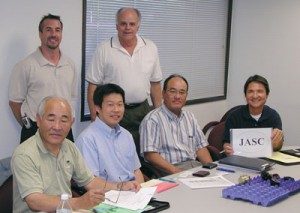
From L to R (sitting): Kensuke Nishimura, President; Mitsuru Nishimura, Assistant Manager, Sales Engineering; Ko Nakayama, Manager, Sales Engineering; and Jun Sakamoto, Marketing Manager, from Seal Tech, Inc. (standing): John Calleja, Engineering Manager; and Harv Jansen, President, of JASC
Printable .pdf version (requires the free Adobe Reader)
JASC Wins Pratt & Whitney SED-WR Award
In June 2005, JASC was awarded a contract to continue development of a multi-channel hot gas valve (HGV) array to distribute high-temperature gaseous JP-7 fuel to various zones of the SED-WR vehicle’s scramjet engine combustor. The design of these flight-ready valves is based on technology developed under prior ground test versions of the valve (GDE-1, GDE-2, and SED-X1).
The vehicle’s propulsion system will be a scramjet (supersonic combustion ramjet) engine, which utilizes storable liquid JP-7 fuel. This fuel is pumped through the engine’s sidewalls – thus cooling the engine and vaporizing the fuel – before reaching the valves. The valves then manage the delivery of the fuel to the engine injectors at temperatures up to 1330 °F – while keeping the close-coupled actuator cool via an ingenious combination of fuel cooling and radiation shielding. These valves will be flight qualified in 2006 and are slated to be tested on a ground-based engine in 2007 (SED-X2). Flight tests of the SED-WR vehicle are scheduled to begin in 2008.
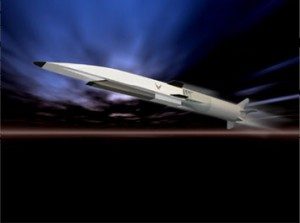
In conjunction with the HGV award, JASC was simultaneously awarded a contract to develop the start control valve for the SED-WR vehicle. Like the HGV, this valve will be fueldraulically actuated and is designed to accurately meter high-pressure, gaseous ignitor fluid to the scramjet engine. This single-channel valve forms the heart of the engine’s start system and will be qualified and tested in parallel with the HGV.
The SED-WR program is being funded through the Air Force’s Hydrocarbon Scramjet Engine Technology (HySET) Program, under the broader Hypersonic Technology (HyTECH) Program. The single-engine demonstrator vehicle will be operating in the Mach 4.5-6.5 range and has both military and commercial applications.
Printable .pdf version (requires the free Adobe Reader)
Back to the Future, Part Two! Meet the X-43A Scramjet!
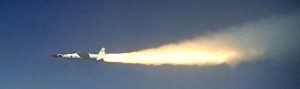
Hyper-X Vehicle X-43A
On November 16th, 2004, Jansen’s Aircraft Systems Controls (JASC), proudly participated in a major milestone for the aerospace community as the Hyper-X Research Vehicle (X-43A) streaked out over the Pacific Ocean at nearly 10 times the speed of sound. After getting a ride from a B-52 to 40,000 feet, the Pegasus booster rocket accelerated the 12-foot-long unmanned X-43A supersonic combustion scramjet vehicle from Mach 0.6 to a speed close to Mach 10. At an altitude of 110,000 feet, the test vehicle traveled at a speed of nearly 7,000 mph (approximately Mach 9.8).
This accomplishment is truly a milestone for the aeronautics community – and the world. It is the second time that an airframe-integrated scramjet (supersonic combustion ramjet) engine was demonstrated in free flight. The initial successful flight, in which JASC also participated, occurred on March 27th, 2004, where the test vehicle flew at a speed of Mach 7 at an altitude of 95,000 feet.
JASC designed and developed the electromechanically-actuated, electronically-controlled ignitor and fuel control valves for the scramjet engine. After the vehicle was jettisoned from the booster and achieved stable flight at nearly Mach 9.8, the vehicle’s engine cowl door opened, allowing air into the engine. The JASC silane ignitor valve was then actuated, followed by the JASC hydrogen fuel valve to sustain and regulate combustion in a process analogous to lighting and keeping a match lit in a hurricane!
The two successful flights were the culmination of over 40 years of effort to demonstrate successful air-breathing hypersonic flight. This is proclaimed to be “the Holy Grail of Flight” by veterans in the aerospace engine community. Both of these X-43A flights superseded the previous record-holding air-breathing engine flight of Mach 3+ by the SR-71 Blackbird and eclipses the X-15 record of Mach 6.7 which used a rocket-powered engine.
In addition to the X-43A fuel control effort, JASC is pioneering the development of high temperature, hydraulically actuated control valves that will allow hydrocarbon fuels to be used in scramjet combustors. The ultimate benefit lies in allowing for low cost, repetitive, high-speed flights for both military and commercial purposes.
JASC founder and president, Harv Jansen, is a true aerospace industry pioneer. He was involved as an engineer on the development of the SR-71’s J-58 engine and the world’s first liquid hydrogen/liquid oxygen rocket engine designated the RL-10. The J-58 engine was as innovative as the SR-71 airframe. To this day, the J-58 remains a state of the art engine in aircraft propulsion. It was the first and only dual-cycle aircraft engine, transitioning from a conventional turbine engine to a ramjet engine at ~Mach 2. It was the first engine to use fueldraulic controls, and the first to use metal seals on tubing joints. Many materials and fluid advancements in use today were spawned from the J-58 engine development program.
More Information: Dryden Flight Research.
Printable .pdf version (requires the free Adobe Reader)
JASC Obtains ISO Registration
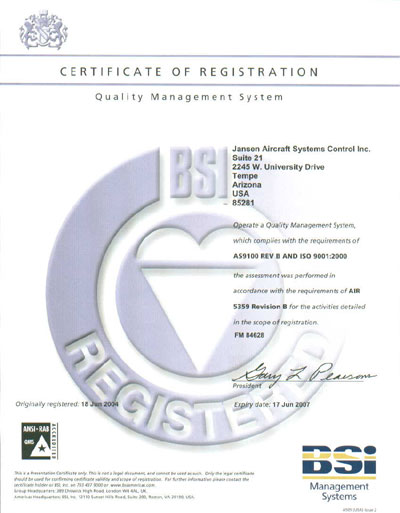
JASC, Inc., located at 2245 W. University Drive, Ste. 21 in Tempe, Arizona, has become registered to ISO9001:2000 and AS9100, Rev. B. The registration is effective June 18th, 2004.
JASC employs some 25 personnel providing customer satisfaction through total program management of OEM products. The company has been in business since 1991.
“We wanted to implement a system to improve our internal processes as well as become more attractive to our customer base, which allows us to become a supplier of choice,” states JASC President and CEO Harvey Jansen. “We feel that ISO and AS9100 registration is key to the company’s future success.”
Jansen’s Aircraft Systems Controls, Inc. designs, manufactures, and repairs engine fuel controls, servo valves, servo actuators, and various fluid control components for aerospace, commercial, and industrial applications.
Printable .pdf version (requires the free Adobe Reader)