
Posts by JASC Controls
Improve Gas Turbine Engine Reliability with Cool Valves and Piping
June 20, 2016 – Combined Cycle Journal
Presentations and discussion at meetings of the gas-turbine users’ groups, such as the 7F, often call into view problems owner/operators are having with the liquid-fuel systems on their dual-fuel engines—in particular, unreliable starts and unreliable fuel transfers from gas to oil. A couple of years ago, the sure solution for some users rarely called to operate on oil was to disable or remove their “unnecessary” liquid-fuel systems. A benefit of this approach was less-complex and less-costly annual inspections.
But yesterday is not today in the continually evolving business of electric generation. Many owner/operators, now unable to operate profitably on energy sales alone, must provide the grid ancillary services to boost revenue. Some of these services require dual-fuel capability to assure reliable power production on oil should gas supplies become tight, or unavailable—as happened in New England a couple of winters ago. Thus some users are re-commissioning their liquid-fuel systems; others are installing liquid-fuel capability on gas-only engines, and liquid-fuel systems are a headline item—once again.
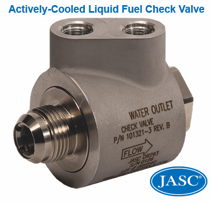
Information shared at user-group meetings points to two ways to improve the reliability of dual-fuel gas turbines (GT) on oil starts and fuel transfers: Continuous circulation of oil through liquid-fuel-system components, and active cooling—including the use of water-cooled valves, manufactured by JASC (Tempe, Ariz), to prevent coking of oil in critical check valves and assure proper seating.
The coking problem many users experience with standard liquid-fuel check valves occurs after switching from oil to gas. Oil remaining in check valves, which is located close to the combustion section of the unit, is exposed to high temperatures. Above about 250F that oil is oxidized. The resulting coke coats check-valve internal surfaces (and fuel lines as well) and restricts the movement of valve parts and the flow of oil.
Once this occurs, a check valve will not open and close properly until it is overhauled, which requires special equipment and skilled technicians to assure its better-than ANSI Class 6 seal in the reverse-flow direction. The most common trip during fuel transfer is on high exhaust-spread temperature—caused almost exclusively by check valves “hung-up” on coked fuel.
To get a first-hand look at the issues faced by owner/operators with dual-fuel GTs, the editors recently spoke with a 7FA user who shared experience from a station equipped with five simple-cycle 7FAs and one 2 × 1 7FA-powered combined cycle. All engines at the facility are equipped for dual-fuel firing and have DLN2.6 combustion systems. Plus, all have JASC water-cooled liquid-fuel check valves—14 per GT (one per combustor). JASC valves were installed on the first engine at this site in 2006. Worldwide, more than 500 industrial gas turbines worldwide now are equipped with JASC water-cooled liquid-fuel valves…
New Shepard Space Vehicle Makes Fourth Flight
JASC congratulates Blue Origin on the fourth flight of its re-useable New Shepard space vehicle on Sunday, June 19.
JASC designed and manufactured the Flight Control System Actuators and the engine Thrust Vector Control Actuators used on New Shepard. Both of these actuators are servo-hydraulic units, with the former used to steer the vehicle and provide aerodynamic stability, and the latter to vector the engine/nozzle for the same purpose.
JASC looks forward to supporting Blue Origin’s actuator needs on many future successful flights. Located in Tempe, AZ, JASC is an engineering solutions provider for the aerospace, space and gas turbine industries.
Virgin Galactic Unveils New SpaceShip2 Unity
On February 19 Virgin Galactic debuted their newest SpaceShip2, named Unity, to a hangar filled with Future Astronauts, partners in the project and members of the media.
Senior officials from The Spaceship Company and Virgin Galactic spoke poignantly about their accident in October 2014, the lessons learned and their determination to carry on.
Stephen Hawking, the preeminent theoretical physicist, has been offered a ride on SpaceShipTwo Unity by Richard Branson. Hawking named the new vehicle and provided an audio clip introducing her.
With the music pumping, the curtains were drawn back to reveal Richard Branson sitting atop a Land Rover pulling Unity. Branson waved to the crowd as the rollout proceeded into the hangar in front of the carrier aircraft WhiteKnight2.
Branson addressed the crowd which was followed by the singing of happy birthday to Branson’s one-year-old granddaughter and then with a milk bottle, Unity was christened.
JASC designed and manufactured several valves for the oxidizer management system aboard SpaceShipTwo Unity. This array of valves provide various functions, including controlling the flow of oxidizer to the engine, loading and unloading the oxidizer to and from the onboard tanks and preventing over-pressurization of the oxidizer system.
JASC looks forward to supporting Virgin Galactic’s needs on many future flights. Located in Tempe, AZ, JASC is an engineering solutions provider for the aerospace, space, and gas turbine industries.
New Shepard Space Vehicle Makes Historic Flight
JASC congratulates Blue Origin on the historic landing of its re-useable New Shepard space vehicle. On November 23, New Shepard launched from the company’s West Texas site, reaching a top speed of Mach 3.7 and an altitude of 100.5 kilometers. The unmanned capsule separated from the launcher and parachuted to earth while the booster made a controlled descent and powered landing at the launch site. This flight marks the first time a rocket booster went to space and returned for a vertical landing back on Earth.
JASC designed and manufactured the Flight Control System Actuators and the engine Thrust Vector Control Actuators used on New Shepard. Both of these actuators are servo-hydraulic units, with the former used to steer the vehicle and provide aerodynamic stability, and the latter to vector the engine/nozzle for the same purpose.
JASC looks forward to supporting Blue Origin’s actuator needs on many future successful flights. Located in Tempe, AZ, JASC is an engineering solutions provider for the aerospace, space, and gas turbine industries.
JASC Sets Industry Standard for Gas Turbine Liquid Fuel System Reliability
 JASC’s Schuyler McElrath was recently interviewed for Energy Power News Las Vegas 2015. Below is the article from that interview.
Schuyler V. McElrath joined JASC in 2004 after 25 years of employment at the GE Energy gas turbine manufacturing facility in Greenville South Carolina. During his tenure at GE, he worked in quality as turbine test operator, test technician, technical specialist, and operations leader for accessory base manufacturing and test. During the last decade of McElrath’s employment with GE, he moved to global sourcing as a sourcing quality engineer where, as the program manager, responsibilities included outsourcing the manufacturing/test of frame 6B and frame 7EA accessory skids. Resolution of fleet issues for both component and system failures were also within the scope of this assignment. The knowledge gained from these challenging roles coupled with JASC’s design acumen has allowed the development of products that set the industry standard for gas turbine liquid fuel system reliability.
Q: Please start by telling us a bit about the company, a brief history of JASC and an overview of your business today.
A: Jansen’s Aircraft Systems Controls (JASC) was founded in 1990 by Harvey Jansen, who had over 50 years of engineering experience in fluid control systems. JASC provides practical engineering solutions for aerospace, space and gas turbine industries as well as providing installation services for power generation facilities.
Q: Please tell us about the company’s products.
A: For the power generation industry, JASC specializes in the design and manufacture of products that enhance the reliability of back-up liquid fuel systems. One of our most significant innovations is the actively cooled valve design. It comes in the form of either a check valve or three-way purge valve. These components have become the foundation for resolving a multitude of issues that have negatively affected back-up liquid fuel system operational capability and reliability for decades. Benefits of actively cooled valves include, but are not limited to, natural gas to liquid fuel transfer success rates approaching 100 percent, no maintenance or service for the fuel system hardware until major turbine outage intervals are reached, and the avoidance of multiple start attempts on liquid fuel. Improved reliability for fuel system components such as flow dividers, fuel pumps, and fuel nozzles have also been achieved. Enhancing gas turbine fuel flexibility with actively cooled valve designs is a simple, inexpensive, yet elegant approach for addressing back-up liquid fuel system reliability.
Q: What would you say makes your business unique?
A: All of JASC’s products were created as a direct result of resolving our valued customers’ field issues. Our in-depth analysis of both hardware and systems has yielded many design innovations that were patentable. Consequently, our unique turbine fuel system expertise allows us to support our customers in a manner that exceeds that of the typical supplier.